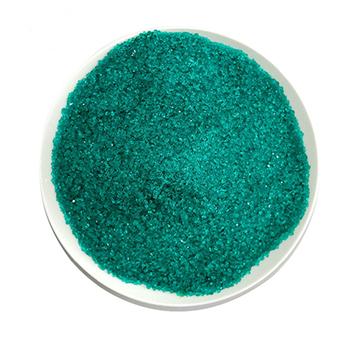

Bromocresol Green, with the CAS number 62625 - 32 - 5, is a commonly used pH indicator. It is a dye that changes color depending on the pH level of the solution it is in. The chemical formula of Bromocresol Green is C₂₁H₁₄Br₄O₅S. It appears as a light - green to yellowish - green crystalline powder.
The solubility of Bromocresol Green is relatively low in water but it can dissolve well in ethanol, methanol, and other organic solvents. The pH range at which it changes color is approximately between 3.8 and 5.4. In acidic solutions (pH < 3.8), it is yellow, and in basic solutions (pH > 5.4), it is blue - green.
One of the primary uses of Bromocresol Green is as a pH indicator in laboratories. It is widely used in titration experiments, especially those involving weak acids and bases. For example, in acid - base titrations to determine the concentration of an unknown acid or base, Bromocresol Green can help to accurately identify the endpoint of the reaction by the color change.
In the field of microbiology, Bromocresol Green can be used in culture media. It can help to monitor the growth of bacteria and fungi. As microorganisms grow and metabolize, they can change the pH of the culture medium, and the color change of Bromocresol Green can provide a visual indication of these changes.
It also has applications in the food industry. Bromocresol Green can be used to test the freshness of certain food products. For instance, it can detect changes in the pH of dairy products, which can be an indicator of spoilage.
When using Bromocresol Green as a pH indicator in titration:
When using it in microbiology culture media:
Case 1: Acid - Base Titration in a Chemistry Laboratory
A chemistry student is tasked with determining the concentration of acetic acid in a vinegar sample. First, a 0.1% Bromocresol Green solution is prepared. A 25 mL sample of vinegar is taken and a few drops of the Bromocresol Green solution are added. The solution turns yellow, indicating an acidic environment. Then, a standardized sodium hydroxide solution is slowly added to the vinegar sample. As the titration progresses, the color of the solution gradually changes from yellow to a greenish - hue. At the endpoint, the solution turns blue - green. By recording the volume of sodium hydroxide solution used, the student can calculate the concentration of acetic acid in the vinegar sample.
Case 2: Monitoring Bacterial Growth in a Microbiology Lab
A researcher is studying the growth of a particular strain of bacteria in a culture medium. Bromocresol Green is added to the culture medium at a concentration of 0.01%. After inoculating the bacteria, the culture is incubated at 37°C. Initially, the culture medium is yellow. As the bacteria

Este é o William, Diretor Executivo da Zhishang Chemical Co., Ltd.
Bem-vindo a visitar a nossa fábrica. Como o principal fabricante de produtos químicos, temos nos esforçado para a qualidade do produto, inovação, P & D e atendimento ao cliente nos últimos 7 anos. Nos próximos 10 anos ou mais, estamos empenhados em nos tornarmos o fornecedor de produtos químicos mais confiável do mundo, criando uma marca internacional bem conhecida e de confiança dos clientes, com o espírito de "um metro de largura, dez mil metros de profundidade", continuamos a nos concentrar na pesquisa e desenvolvimento de produtos, continuamos a nos concentrar no atendimento ao cliente, continuamos a melhorar o sistema de serviço da cadeia de suprimentos, para criar uma equipe profissional de serviços de fornecimento de produtos químicos, para alcançar uma cooperação de longo prazo ganha-ganha. Por favor, não hesite em contactar-nos se tiver alguma dúvida.