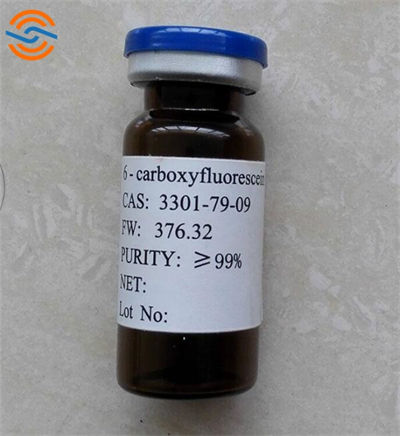

6 - carboxyfluorescein, with the CAS number 3301 - 79 - 9, is a well - known fluorescent dye. It is often supplied by factories at the best price. The chemical formula of 6 - carboxyfluorescein is C₂₁H₁₂O₇, and it has a molecular weight of approximately 376.31 g/mol. It appears as a solid powder with a characteristic color, usually orange - red. This product is highly soluble in some organic solvents such as dimethyl sulfoxide (DMSO) and methanol, which makes it convenient for various applications. In terms of fluorescence properties, it has an absorption maximum around 492 nm and an emission maximum around 518 nm, emitting a bright green fluorescence under appropriate excitation light.
6 - carboxyfluorescein has a wide range of applications in different fields. In the biological research field, it is commonly used as a fluorescent tracer. For example, in cell labeling experiments, it can be used to label cells to track their movement, division, and interaction in a biological system. It can also be used in the study of membrane permeability. By loading 6 - carboxyfluorescein into cells, researchers can observe how substances pass through the cell membrane by detecting the fluorescence change. In the field of immunology, it can be conjugated to antibodies, and then these fluorescently labeled antibodies can be used for immunofluorescence staining to detect specific antigens in tissues or cells. In addition, in the field of drug delivery research, 6 - carboxyfluorescein can be used to monitor the release of drugs from drug carriers, helping researchers to understand the drug release process and efficiency.
When using 6 - carboxyfluorescein, proper handling is crucial. First, wear appropriate personal protective equipment, such as gloves and goggles, to avoid direct contact with the skin and eyes. When preparing a solution, accurately weigh the required amount of 6 - carboxyfluorescein and dissolve it in a suitable solvent, usually DMSO or methanol. The concentration of the solution should be adjusted according to the specific application requirements. For cell labeling, the solution is usually diluted further in a cell - culture medium. The labeled cells should be incubated at an appropriate temperature and time to ensure effective labeling. When using it for immunofluorescence staining, the fluorescent - labeled antibodies need to be prepared in advance, and then the staining process should follow the standard immunofluorescence staining protocol, including blocking, primary antibody incubation, fluorescent - labeled secondary antibody incubation, and washing steps.
Case 1: Cell Migration Study
In a cell migration study, researchers wanted to observe the migration ability of a certain type of cancer cells. They first labeled the cancer cells with 6 - carboxyfluorescein. They prepared a 1 mM solution of 6 - carboxyfluorescein in DMSO and then diluted it to 10 μM in the cell - culture medium. The cancer cells were incubated with the diluted solution for 30 minutes at 37°C. After washing the cells to remove the excess dye, the labeled cells were seeded in a migration chamber. By using a fluorescence microscope at different time points, they could clearly observe the movement of the labeled cancer cells towards a chemo - attractant. This experiment helped them understand the metastasis mechanism of cancer cells and provided a basis for developing anti - metastasis drugs.
Case 2: Immunofluorescence Staining in Tissue Samples
In a study of a specific disease - related antigen in tissue samples, researchers used 6 - carboxyfluorescein - labeled antibodies. First, they fixed the tissue samples and then blocked non - specific binding sites. They incubated the samples with the primary antibody specific to the antigen overnight at 4°C. After washing, they incubated the samples with the 6 - carboxyfluorescein - labeled secondary antibody for 1 hour at room temperature. After another washing step, they observed the samples under a fluorescence microscope. The bright green fluorescence clearly showed the distribution of the antigen in the tissue, which was helpful for understanding the pathological mechanism of the disease.
If you have any questions or need further information about Factory Supply 6 - carboxyfluorescein cas 3301 - 79 - 9, please feel free to contact us. Our email address is info@vivalr.com, and our phone number is (86) 158667

Este é o William, Diretor Executivo da Zhishang Chemical Co., Ltd.
Bem-vindo a visitar a nossa fábrica. Como o principal fabricante de produtos químicos, temos nos esforçado para a qualidade do produto, inovação, P & D e atendimento ao cliente nos últimos 7 anos. Nos próximos 10 anos ou mais, estamos empenhados em nos tornarmos o fornecedor de produtos químicos mais confiável do mundo, criando uma marca internacional bem conhecida e de confiança dos clientes, com o espírito de "um metro de largura, dez mil metros de profundidade", continuamos a nos concentrar na pesquisa e desenvolvimento de produtos, continuamos a nos concentrar no atendimento ao cliente, continuamos a melhorar o sistema de serviço da cadeia de suprimentos, para criar uma equipe profissional de serviços de fornecimento de produtos químicos, para alcançar uma cooperação de longo prazo ganha-ganha. Por favor, não hesite em contactar-nos se tiver alguma dúvida.